By Chris Wilburn | Fractional COO | Operations Executive
When More Isn’t the Answer
If you’re leading a small to mid-sized business and feel like you’ve tried everything to reach the next level (new hires, new tools, new processes), but performance is still plateaued, you’re not alone.
What I have found is that in many cases, the problem isn’t what’s missing, it’s what is in the way. In other words, growth stalls when complexity grows organically, like weeds in a garden.
That was the case when I stepped into an organization that, on paper, had everything: smart people, deep expertise, and a strong client base. But something wasn’t working.
The Problem Beneath the Plateau
The organization was structured around five distinct verticals. Each vertical had its own processes and its own team with deep subject matter expertise. There just was no one connecting the dots.
- Each team operated in a silo.
- Each customer interaction required multiple handoffs.
- Each handoff came with knowledge loss, delays, and frustration.
The Impact?
High-quality individuals were performing numerous small tasks, but no one was delivering comprehensive value to the customer.
Interestingly, no one function was “broken,” but the system as a whole was constrained. Customers were bounced between departments, internal teams were stretched thin, and the business couldn’t scale.
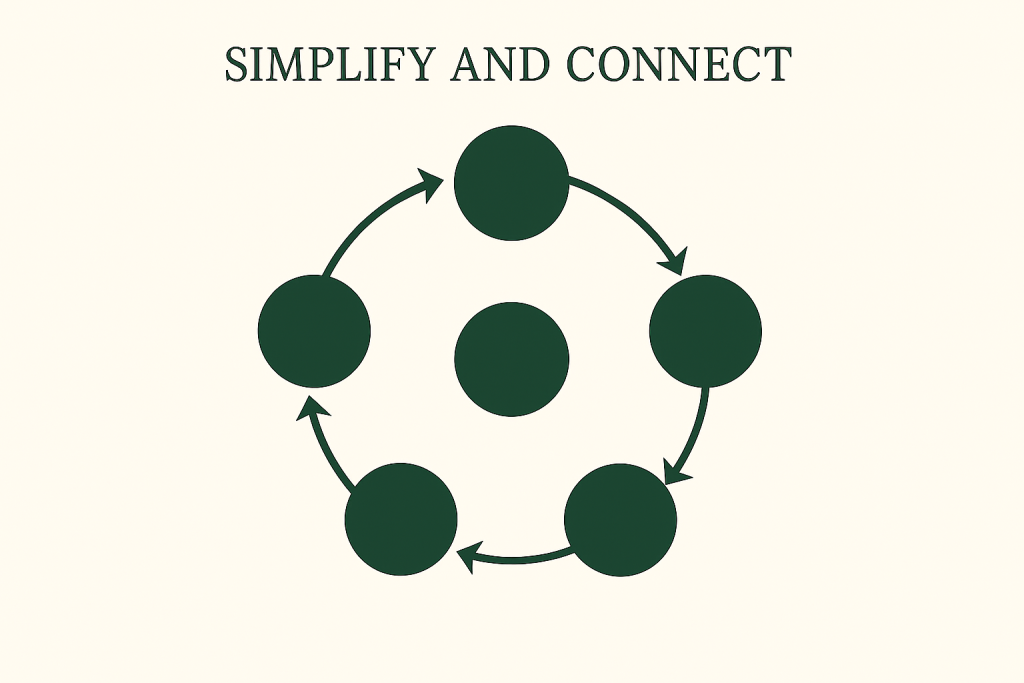
Introducing a North Star: Simplify and Connect
To drive cultural and operational change, we introduced a guiding principle:
Simplify and Connect
This became our North Star.
- Simplify operations by removing handoffs, redundant admin tasks, and unused reports.
- Connect the five verticals to create a logical, flowing cycle of information and services.
Every decision was filtered through this lens:
- “Does it simplify?”
- “Does it connect?”
If it didn’t do either, we didn’t implement it, period
This clarity made transformation possible, and most importantly, sustainable throughout the organization.
The Solution: A Tip-of-the-Spear Team
We created a new team with a clear mission:
Become the single point of contact between the five verticals and the customer.
Most importantly, this team wasn’t meant to replace the deep expertise of the verticals. It was designed to:
- Provide horizontal coverage across all functions
- Reduce handoffs and streamline communication
- Funnel requests to the right vertical experts and return with solutions
- Own the customer relationship from start to finish
Make no mistake, executing this wasn’t easy. We had to take individuals who were experts in one vertical and help them grow into generalists who could operate across all five and, in parallel, build progressive workflow changes across all of the vertical functions to support them all while still meeting customer deliverables through the transition.
This was much more than a structural change; it was a mindset shift, and it worked.
The Results: From Ground-Level to 5,000 Feet
Within three months, we started to see wins:
- The horizontal team cross-trained their peers.
- Handoffs were reduced by 40%
- Vertical teams saw a boost in productivity due to fewer customer interruptions.
- Each function was delivering measurably higher value to customers.
- Customers praised the single point of contact model
- The team delivered higher-quality service with fewer customer touchpoints
By streamlining workflows and eliminating redundancy, the team managed the same volume of work with a higher level of quality and less collective effort.
Why a Fractional COO Was the Right Fit
As a fractional COO, I brought:
- Fresh perspective without internal bias
- Long-term commitment to the organization’s success
- Strategic leadership embedded in the team and accountable—not just advising from the sidelines
Unlike consultants who deliver a report and leave, I stayed. I led. I refined. I helped the team evolve this operating model for years and certainly didn’t leave after the first win.
From Reactive to Strategic: The Power of Simplification
This team didn’t just solve a problem; they became a strategic asset by accomplishing the following:
- Freed up resources that could be redeployed to other client projects.
- Elevated the customer experience.
- Created space for the vertical teams to focus on what they do best.
We didn’t add more to get the results; we just removed what was suffocating growth:
- Endless customer interactions across departments
- Time-consuming handoffs
- Artificial constraints on scope
We pulled the weeds out of the garden, and the plants started to grow.
Top Benefits of Hiring a Fractional COO
- Unlock cross-functional collaboration
- Simplify operations and reduce waste
- Improve customer experience
- Increase team productivity
- Gain strategic leadership without full-time cost
- Drive long-term cultural change
Final Thoughts: Cultivating What’s Already There
If you’re a leader stretched thin, you already know how hard it is to step back and tend to the garden. There is always another fire to put out.
But sometimes, the function that isn’t broken is the one with the most potential.
It just needs space to grow.
That’s what a fractional COO can do. We don’t just fix what’s broken, we help you unlock what’s possible.
Let’s Talk
📞 Schedule a free 30-minute consultation
🌐 Visit clewbusinessservices.com
Because you weren’t meant to do this alone.